Some Cases Need To Be Tried…

Some Cases Need to Be Tried…
By Raymond L. Niblock

I was raised in the courtroom. My father was a trial lawyer, and from an early age, I understood that trials were where real advocacy lived. When I came up in the profession, the prevailing wisdom among trial lawyers was simple: “Get your client, your witnesses, and bring your satchel to court.”

If you call yourself a trial lawyer, then get in there—call a witness, ask a question, introduce an exhibit, make your argument. That’s the work. Lawyers don’t decide cases. That’s what judges and juries are for.
Even though I’m a mediator, I’m also a trial lawyer, and I still believe that some cases simply need to be tried. Whether because of unsettled law, disputed facts, or a client’s principle that cannot be compromised, there will always be matters that belong in a courtroom. Trial work remains vital to the legal system and to the public’s trust in it.
But recognizing that truth doesn’t diminish the importance of mediation. In fact, it enhances it. The vast majority of cases filed in our courts settle before trial—by some estimates, well over ninety percent of them do.¹ In state courts, only about three percent of civil cases are resolved by trial,² and in federal court, the number is closer to one percent.³
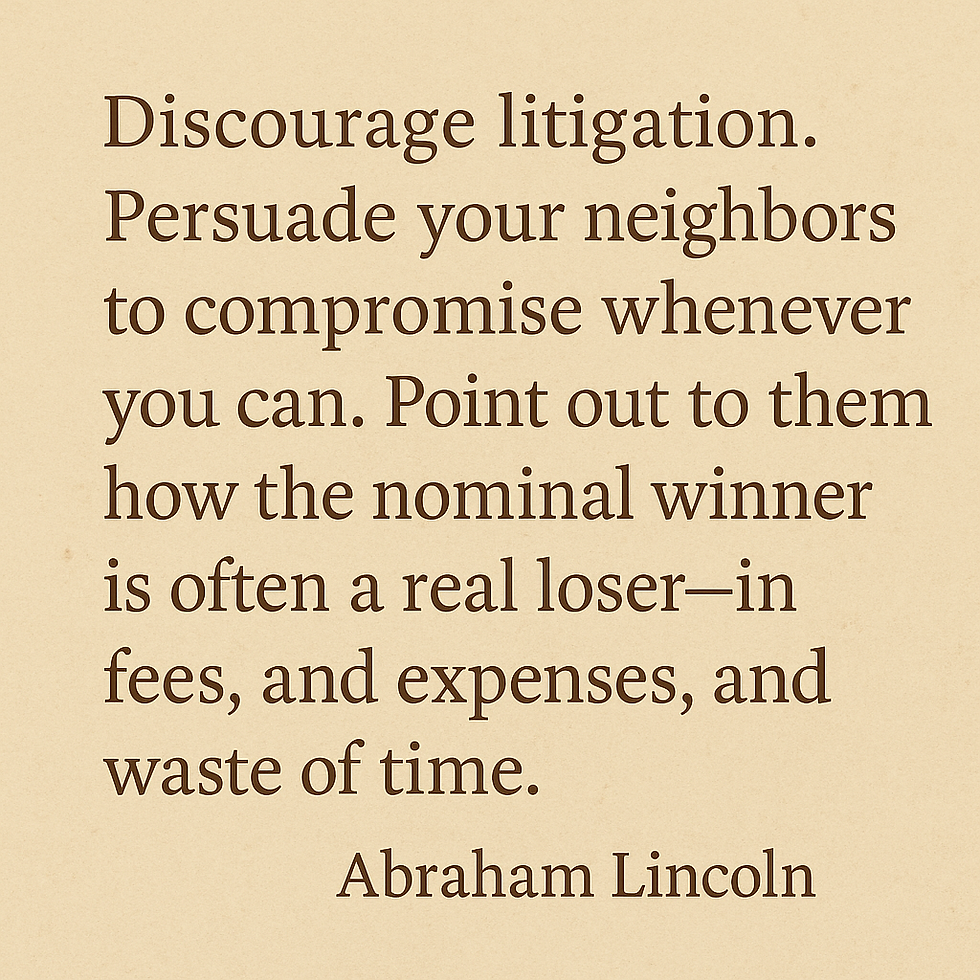
As Abraham Lincoln wisely counseled more than a century and a half ago, “Discourage litigation. Persuade your neighbors to compromise whenever you can. Point out to them how the nominal winner is often a real loser—in fees, expenses, and waste of time.”⁴
Even in cases that are ultimately headed for trial, mediation can help lawyers and their clients narrow the issues, clarify the real disputes, and test the strengths and weaknesses of their positions. Sometimes, a day in mediation can do more to focus a case than weeks of discovery or motion practice.
Justice Sandra Day O’Connor put it well: “The courts of this country should not be the places where resolution of disputes begins. They should be the places where the disputes end after alternative methods of resolving disputes have been considered and tried.”⁵
For lawyers, mediation isn’t an alternative to advocacy—it’s another forum for it. A good mediation allows counsel to advocate, persuade, and problem-solve, but in a setting designed to produce resolution rather than verdicts.
Some cases need to be tried. Most do not. But every case deserves a fair opportunity to settle—and mediation is where that opportunity lives.
Endnotes
1. See “What Percentage of Lawsuits Settle Before Trial?” The Law Dictionary,

2. Brian J. Ostrom and Neal B. Kauder, Examining the Work of State Courts, 2005: A National Perspective from the Court Statistics Project (Williamsburg, VA: National Center for State Courts, 2006), 22–23.
3. Marc Galanter, “The Vanishing Trial: An Examination of Trials and Related Matters in Federal and State Courts,” Judicature 88, no. 1 (July–August 2004): 1–9.
4. Abraham Lincoln, quoted in “Three Quotations from Lincoln on Conflict Resolution,” Mediate.com,

5. Sandra Day O’Connor, quoted in “Quotes: Collaboration, Settlement & Resolution,” BLC Law Center,



Comments